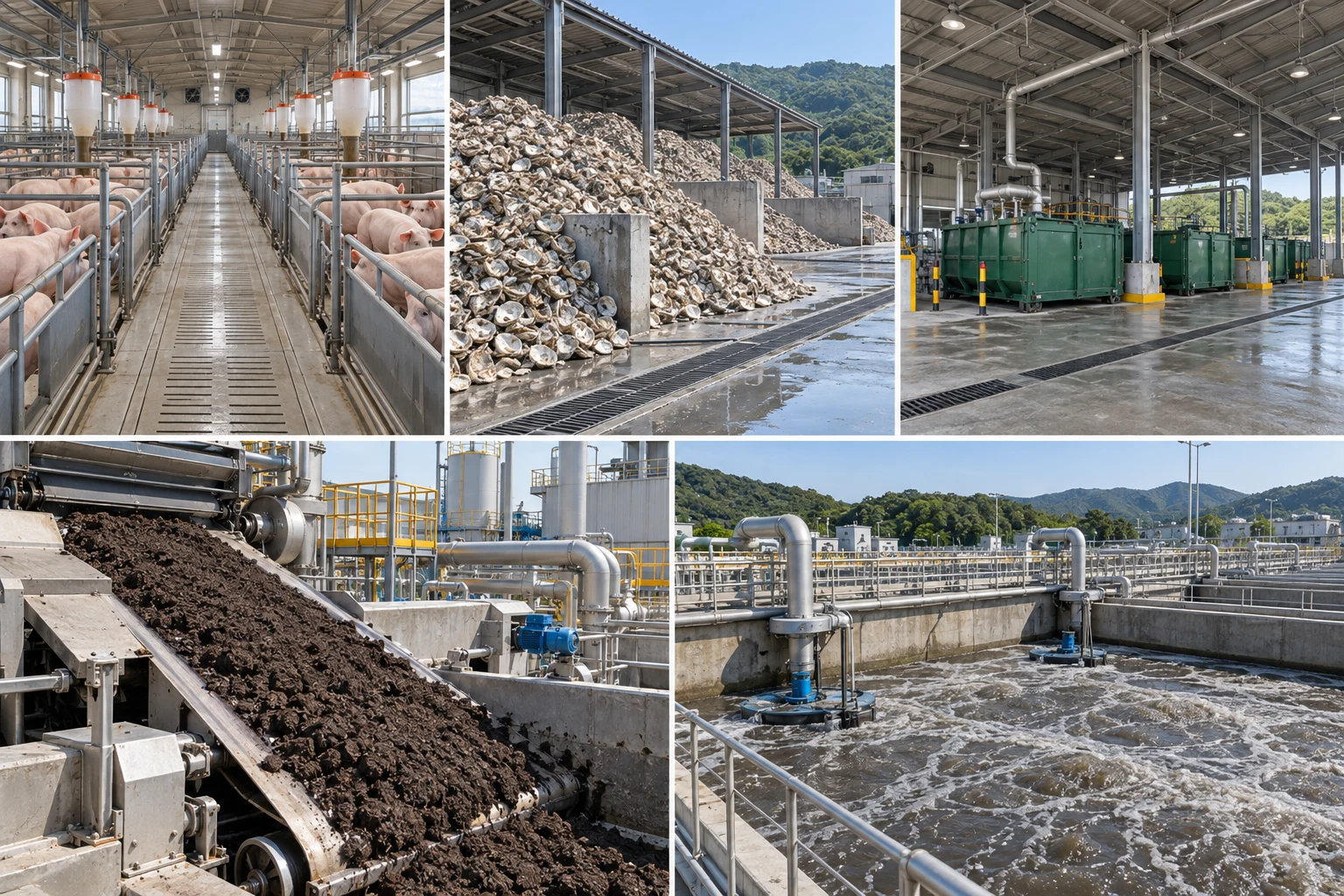
Assess odor sources in livestock, shell storage, food waste, sludge and wastewater; design site-specific chemicals and operating processes.
01Livestock facilities
Separate manure, floor residues, storage and exhaust points. Identify ammonia or sulfur compounds by measurement and review species, animal presence, feeding, manure handling and ventilation. Prioritise cleaning, waste recovery and capture before selecting compatible products. Animal, feed or drinking-water contact requires separate suitability review.
02Shell storage and processing
Assess residual organic matter on shells, storage time, standing water and leachate. Combine residue removal, drainage, shorter storage and area separation with cleaning and odor-care products. Check recycling objectives and wash-water handling; do not apply strong acids indiscriminately to shells.
03Food-waste facilities
Diagnose intake, storage, sorting, transfer, containers, floors and leachate separately. Combine organic-matter removal, container washing, residence-time control and enclosure/capture. Distinguish surface products from captured-gas treatment chemicals; assess organic load, pH changes and effluent impact.
04Sewage-treatment sludge
Review thickening, storage, dewatering, loading and transfer. Analyse ammonia, amines or reduced sulfur compounds as appropriate. Separate surface care from captured-gas treatment; evaluate effects on polymers, dewatering and disposal/reuse. Odor products do not substitute for sludge stabilisation or statutory treatment.
05Industrial wastewater treatment
Assess loads and timing in inlet, collection, equalisation, process and sludge areas. Review water pH, organics, oxygen and gas data, including biological-process compatibility. Direct water dosing, surface treatment and scrubber chemicals are distinct applications; do not dose without confirmed conditions.
BIOCLEAN · CONTINUOUS DEVELOPMENT
Why choose this product range
Over 25 years of development experience — research continues todayKorea Total Service continues researching products and application processes, drawing on more than 25 years of development experience. Customer requirements are our starting point: we connect soil sources, materials and actual working conditions when developing product specifications.
Product-specific technical priorities
Livestock, shell waste, food waste, sludge and wastewater odors have different sources and compositions. Organic accumulation, moisture, process and capture conditions guide site-specific chemical use combined with cleaning, ventilation and equipment management.
Designed around the soil
We distinguish soil types, depth and sources to discuss specifications for cleaning, removal or protection.
Materials and process together
We assess surface changes, recovery, rinsing, drying and follow-up care alongside cleaning objectives to propose usable field methods.
Custom development and improvement
Manufacture after order is our basic policy, including general-purpose products. Customer requirements and application feedback inform subsequent specifications.
From customer requirements to product specifications
- Review photos, materials, contamination, operating conditions and objectives
- Select product and process options; discuss samples or spot trials when needed
- Manufacture and supply to agreed specifications, with application guidance
- Review outcomes and maintenance records to discuss improvements
Attach photos and discuss specifications ↗Final ingredients, instructions, SDS and performance documentation are provided for the agreed product specification. These are development and selection criteria, not quantified guarantees of identical outcomes in every condition.
Supply and technical consultation
Product planning / custom development and supply consultation. Composition, concentration, dilution, dose, packaging and price are discussed after site review and testing. Assess sources and treatment processes rather than relying solely on fragrance masking.
Send facility type, location, sources and timing, area/capacity, current chemicals/equipment, measurements and photos.
Discuss odor management ↗ Technology for customers, care for the environment
 한국어
한국어 English
 日本語
日本語 Tiếng Việt
 Filipino