 한국어
한국어 English
 日本語
日本語 Tiếng Việt
 Filipino
Designed around the soil
We distinguish soil types, depth and sources to discuss specifications for cleaning, removal or protection.
 Technology for customers, care for the environment
BIOCLEAN / SOLAR CLEAN & PROTECT
← Specialty chemicalsRemove surface contamination while carefully managing module glass and its existing coating.
Chemical price only. Confirm fill volume, tax, delivery and supply specifications when ordering. Cleaning-service costs are quoted separately.
Custom product consultation.
Ask about solar-panel products ↗BIOCLEAN · CONTINUOUS DEVELOPMENT
Korea Total Service continues researching products and application processes, drawing on more than 25 years of development experience. Customer requirements are our starting point: we connect soil sources, materials and actual working conditions when developing product specifications.
Solar cleaning considers soil removal together with optical and surface conditions. Dust, pollen and bonded soil are distinguished; glass, AR coatings, frames, seals and rinse residue guide separately specified cleaning and protection conditions.
We distinguish soil types, depth and sources to discuss specifications for cleaning, removal or protection.
We assess surface changes, recovery, rinsing, drying and follow-up care alongside cleaning objectives to propose usable field methods.
Manufacture after order is our basic policy, including general-purpose products. Customer requirements and application feedback inform subsequent specifications.
Final ingredients, instructions, SDS and performance documentation are provided for the agreed product specification. These are development and selection criteria, not quantified guarantees of identical outcomes in every condition.
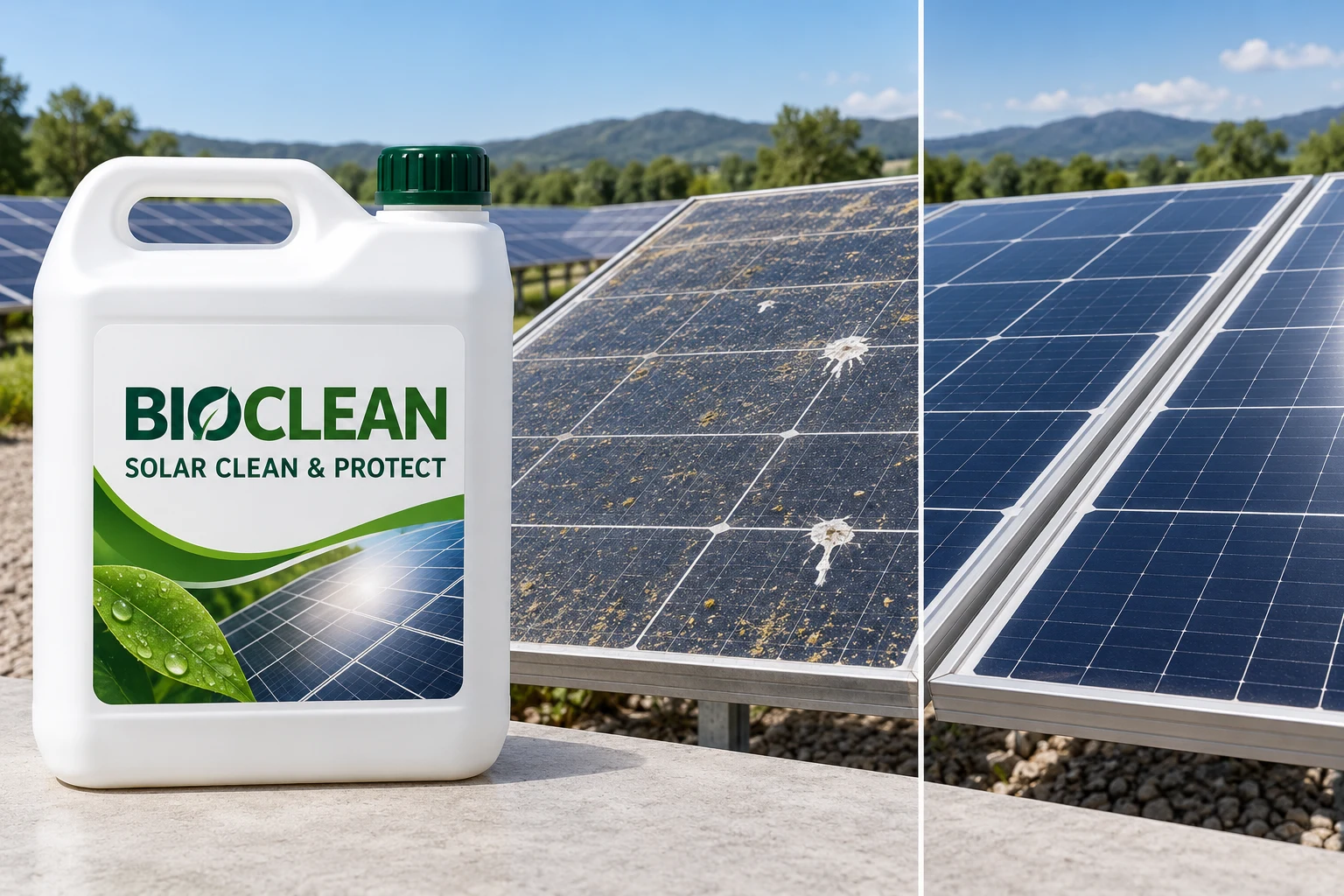
Inspect dust, pollen, bird droppings and oily contamination on front glass. Remove soiling under approved conditions to reduce obstruction of incoming light and recover soiling-related energy losses.
Use non-abrasive tools, compatible chemistry, rinsing and residue checks to reduce damage risk to existing glass and anti-reflective coatings. New protective-film performance, durability and warranty compatibility require testing and approval.
| Check | Uncleaned condition | Expected change after compatible cleaning |
|---|---|---|
| Optical soiling | Dust and pollen may obstruct light. | Remove contamination obstructing light transmission. |
| Localized shading | Droppings and leaves may shade cells. | Remove obstructions and inspect; cleaning does not repair hot spots or damaged cells. |
| Energy yield | Site-specific soiling may reduce energy production. | Some soiling losses may be recovered; rated module output is not increased. |
| Surface care | Contamination requires assessment. | Gentle cleaning, rinsing and checks of glass, coating, frames and seals. |
| Residue | Check existing deposits. | Check that detergent or hard-water residue has not left new marks. |
IEA PVPS’s September 2025 fact sheet describes average global soiling-related energy losses of 4–7%. This industry estimate does not guarantee a product-specific cleaning gain. Field observations and modeled scenarios are distinguished below.
Water-repellent or anti-soiling films require module-specific approval. Assess optical transmission, reflection, AR-coating compatibility, adhesion, weathering, re-soiling and warranty terms. A blanket coating or permanent no-cleaning claim is not offered.
Rain and tilt can remove some soiling. Inspection determines the need and economic value of cleaning.
Coverage requires finalized fill volume, dilution, application rate and contamination assessment.
Basic care protects existing surfaces during cleaning. Additional films require separate compatibility tests and approval.
General PV guidance, not BIOCLEAN performance certification or manufacturer endorsement. Checked 11 October 2026.